
Interview by Zeta Tzioti
From the classrooms of Pratt Institute in New York to the pages of Athens Voice and contemporary Greek literature, George Dimos has followed a path in which writing has always been at the forefront. Journalist, columnist and author, he now introduces himself through his first collection of short stories, Seven Days in Hell, published by Iolkos Editions.
– George, Seven Days in Hell is your first book. How did you begin writing it? Are the stories presented in the chronological order in which they were written, or is there another thematic connection between them?
Seven Days in Hell was written gradually over a long period of time. I began writing some of the stories while I was still a student at Pratt Institute, while others were published in the online literary magazine Monocle between 2022 and 2024. So, no, the stories are not presented in the chronological order in which they were written. Is there a thematic continuity? I’m not entirely sure, but all the stories in the collection are connected in some way and form a unified whole. They are works of fantasy fiction, with some leaning more toward horror literature. While writing them, I was influenced by the stories of Edgar Allan Poe, Ambrose Bierce, Arthur Machen and H. P. Lovecraft, to mention just a few important names.
– How do you begin writing such a story? Where do you usually draw your inspiration from?
Different things inspire me. It could be a film I’ve watched, a book I’ve read, a song I’ve listened to, or even a dream I’ve had. Sometimes inspiration also comes from things I’ve experienced myself, although these particular stories are not based on my personal experiences. For example, in the story Anesthesia, a doctor tells the main character, “Now I’m going to drown you,” before examining his throat. A doctor actually said that to me once before examining my throat—jokingly, of course. Nevertheless, I found it strangely threatening, especially coming from a doctor, who at that moment exercises a certain authority over you, and I decided to include it in the story’s dialogue. I start writing when I have three or four ideas that can somehow be combined. I never begin with a single idea because I know I’ll soon get stuck and won’t be able to develop it properly.
– Fish from Japan is the first story in the collection. Here, you address the horror of nuclear catastrophe while adopting a contradictory, almost cheerful tone. Tell us about this choice.
This is actually a very old literary technique. One of the earliest examples is Jonathan Swift’s essay A Modest Proposal (1729), in which the Anglo-Irish writer and clergyman seriously suggests that poor Irish people should begin eating their own children, thereby eliminating hunger among the lower classes and reducing a population that was supposedly growing at a problematic rate. Swift, of course, did not mean what he wrote; rather, he was criticizing the indifference of the upper classes toward poverty in Ireland. Fish from Japan deals with a horror so immense that it is almost impossible to discuss it seriously. Ever since nuclear weapons were first developed and used at the end of World War II by the United States against Japan, they have been a source of terror for all of us, and governments and the media periodically remind us of their existence. I do not believe that the nuclear threat is a joke; on the contrary, it is something so dark that the human mind struggles to comprehend it.
– The title of the book evokes biblical imagery. However, as we read on the back cover, that was not one of your intentions. What does the title refer to, and what led you to choose it?
The collection was originally titled Journey to Hell, which was also the title of the story when it appeared in Monocle. I borrowed it from an album by the now almost forgotten psychedelic band C.A. Quintet from the 1960s, called Trip Thru Hell. The album cover depicts a desolate landscape somewhere in America, with a large dead tree and a group of Native Americans gathered beneath it, apparently performing a rain dance.
Those who read the story Seven Days in Hell will understand the connection. However, I never wanted to give readers the impression that the book deals with matters of religious faith. If there is any such allusion, it has far more to do with Arthur Rimbaud’s A Season in Hell (1873) than with the Bible.
– How does it feel to have published your first book? What was the dominant emotion you experienced when you held it in your hands for the first time?
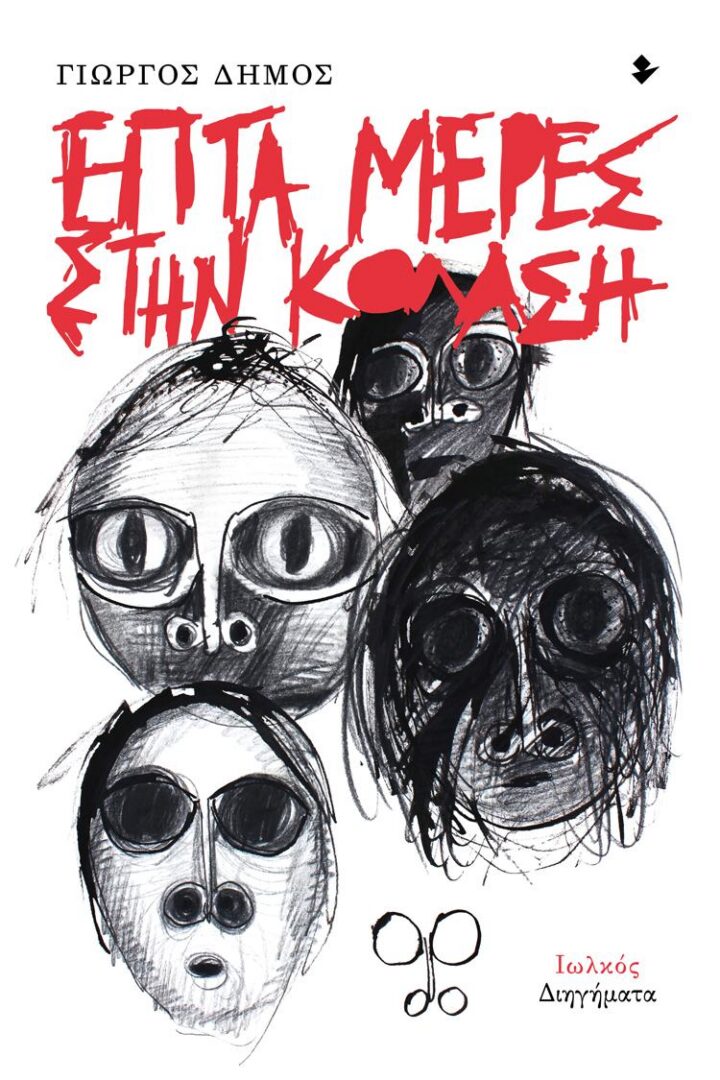
It was a unique moment. What impressed me most was the response from the people around me. There was immediate enthusiasm, and many rushed to buy the book even before there had been a presentation or any real promotion on my part. I also believe that excellent work was done regarding both the cover design and the editing by my publisher, Konstantinos Koridis. It is an adventure full of surprises, and one that is truly worth experiencing.