Written by Zeta Tzioti
Against the backdrop of Crete’s timeless landscape and the shimmering expanse of the Mediterranean Sea, a remarkable new public artwork has taken its place at Minos Palace Resort in Agios Nikolaos. Created by Canadian artists Caitlind Brown and Wayne Garrett, Chronotopia, the monumental installation was selected as the winning proposal of the 2026 Mamidakis Foundation Art Prize, an internationally recognized distinction that continues to strengthen the dialogue between contemporary art, cultural heritage, and the unique environment of Crete.
The Mamidakis Foundation Art Prize has established itself as one of Greece’s most significant platforms for site-specific contemporary art, inviting artists from around the world to engage with the island’s landscape, history, and cultural identity. For the 2026 edition, the competition attracted approximately 450 submissions from numerous countries, reflecting the growing international prestige of the award. From this highly competitive field, the proposal by Brown and Garrett emerged as the winning project, distinguished by its poetic engagement with place, its participatory character, and its ability to connect contemporary artistic practice with universal human concerns.
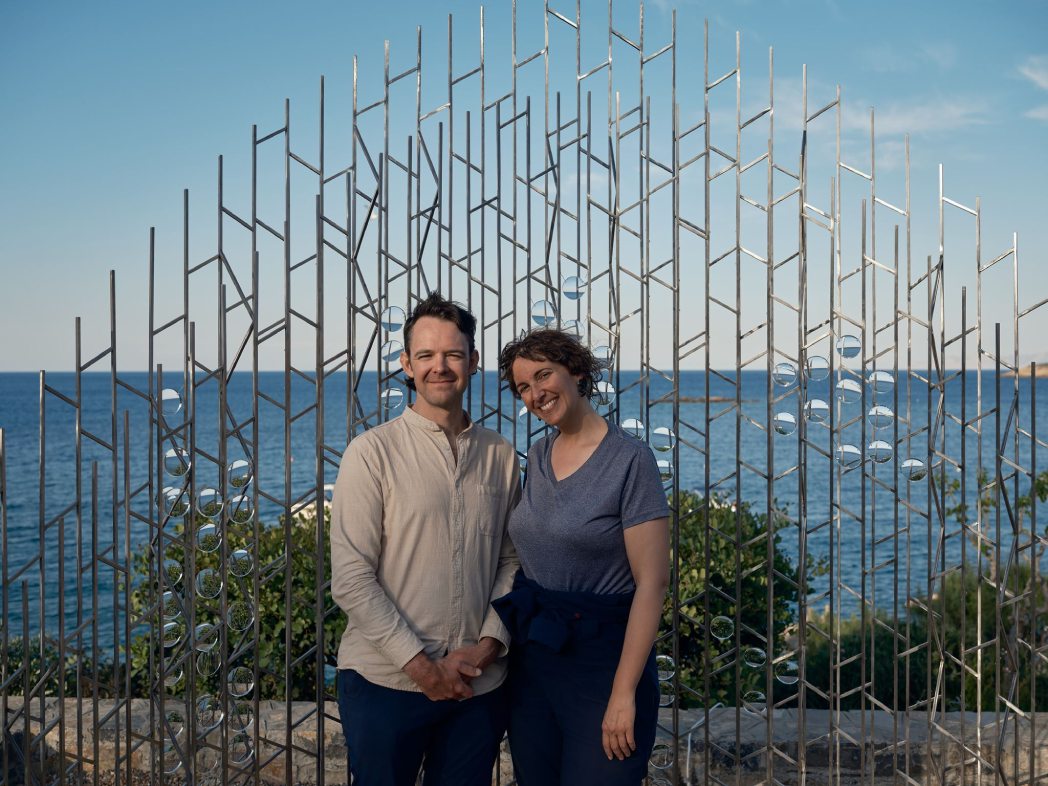
The installation was officially unveiled during a special ceremony held at Minos Palace Resort, attended by the owner of the resort and founder of the Mamidakis Foundation, Gina Mamidakis, alongside her son, George Mamidakis, President of the Foundation. Also present were the Foundation’s directors, members of the selection committee, representatives of the cultural community, and invited guests who gathered to celebrate the realization of the award-winning work.
At the heart of the installation lies the powerful symbolism of the circle. One of humanity’s oldest and most enduring forms, the circle has long represented continuity, harmony, celestial cycles, and collective belonging. Brown and Garrett transform this universal symbol into an immersive spatial experience that draws inspiration from Crete’s mythology, history, and relationship with the sea. The circular structure evokes the sun and the moon, the cycle of life, and the eternal movement of nature, while simultaneously opening a contemporary dialogue about community, participation, and democratic values.
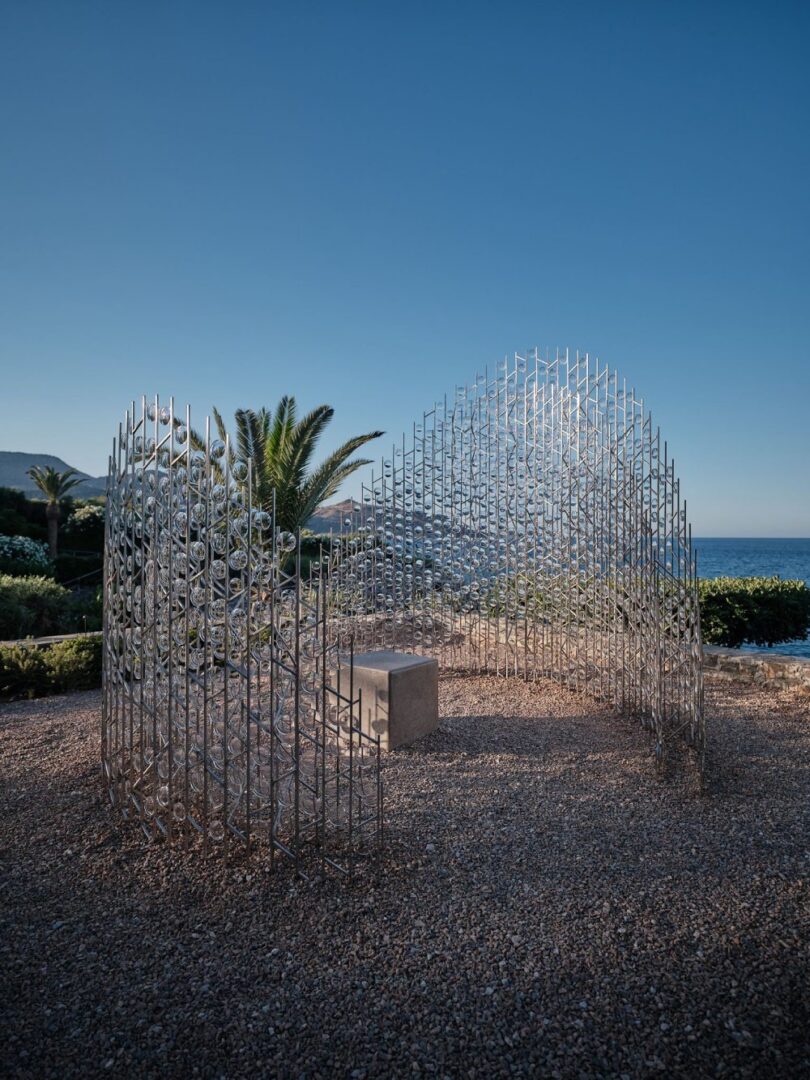
Photo by Loukianos Arnaoutakis (Mamidakis foundation)
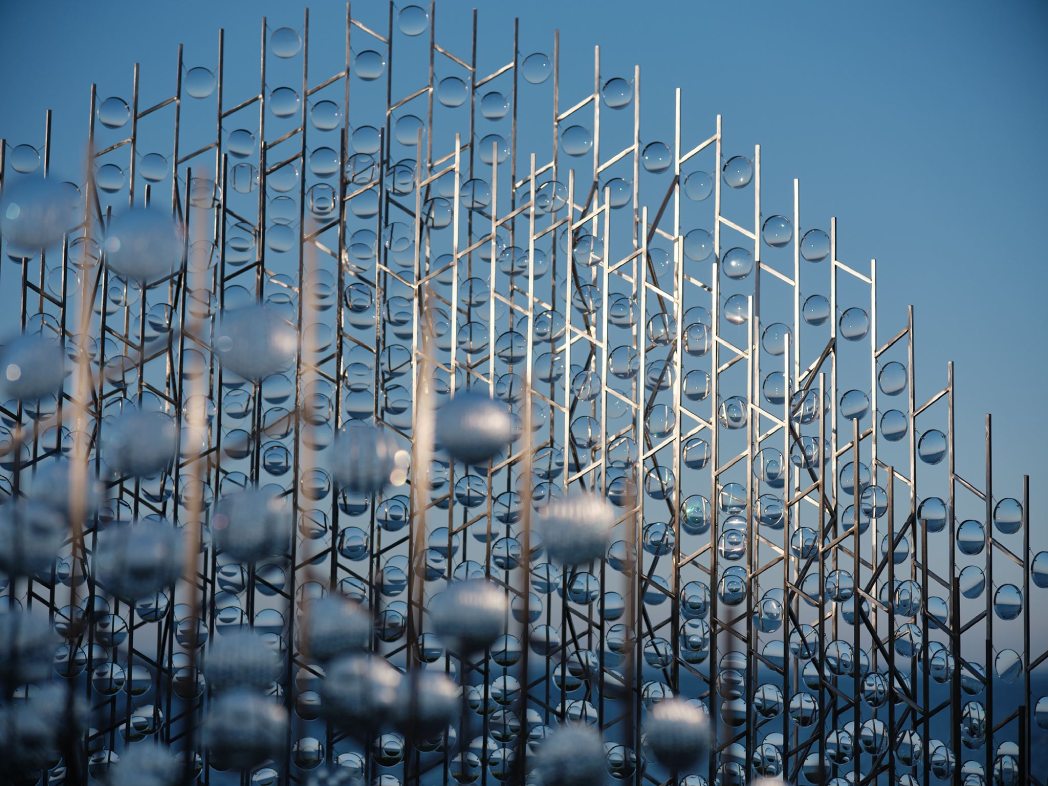
For the Canadian artists, the Mediterranean environment presented both a challenge and a source of inspiration. The sea, the horizon, and the island’s layered cultural history became integral components of the work. Rather than competing with the spectacular natural setting, the installation operates as a viewing instrument, framing and amplifying the surrounding landscape. It functions almost like a lens that gathers light, captures fragments of the horizon, and focuses attention on the extraordinary beauty of the site.
Importantly, the structure never obstructs the view. Instead, it enhances perception, encouraging visitors to engage more deeply with their surroundings. The artwork collects and redirects sightlines toward the sea, the coastline, the sky, and the changing Mediterranean light. Every encounter becomes unique, shaped by weather conditions, time of day, and the position of the observer.
One of the most fascinating aspects of the installation is the multiplicity of perspectives it generates. Through its carefully considered geometry, visual possibilities expand dramatically as visitors move around and through the work. New alignments emerge continuously, creating a dynamic sequence of viewpoints that seem to multiply with each step. The installation offers not a single image but countless visual experiences.
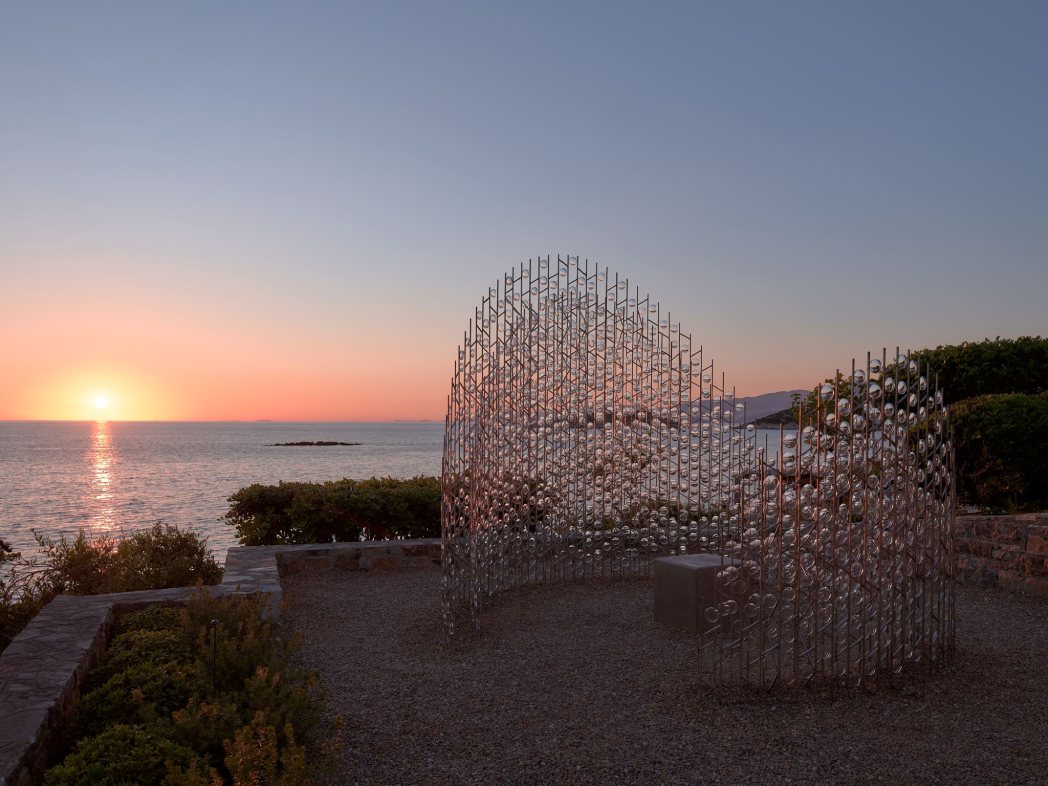
Photo by Loukianos Arnaoutakis (Mamidakis foundation)
This phenomenon is particularly striking because the work can be approached from multiple directions and perceived differently from land and sea. Viewed from the coastline, it establishes a dialogue with Crete’s terrain and architectural heritage. Seen from the water, it becomes a landmark integrated into the broader landscape of the bay. These shifting perspectives create an artwork that remains in constant transformation, inviting multiple interpretations depending on context, movement, and personal experience.
Such plurality of viewpoints resonates profoundly with the principles of democracy. The installation can be understood as a symbolic celebration of democratic thought, where no single perspective dominates and every position contributes to a richer collective understanding. Diversity of vision becomes a metaphor for diversity of opinion. The work acknowledges that meaning is never fixed but emerges through dialogue, coexistence, and mutual respect.
This democratic dimension is reinforced by the participatory nature of the piece. Visitors are invited to enter the structure, sit within it, pause, converse, reflect, or simply observe the landscape unfolding around them. The artwork creates a rare condition of public intimacy, transforming a shared environment into a personal experience. The viewer is not merely an observer but an essential collaborator whose presence activates the work.
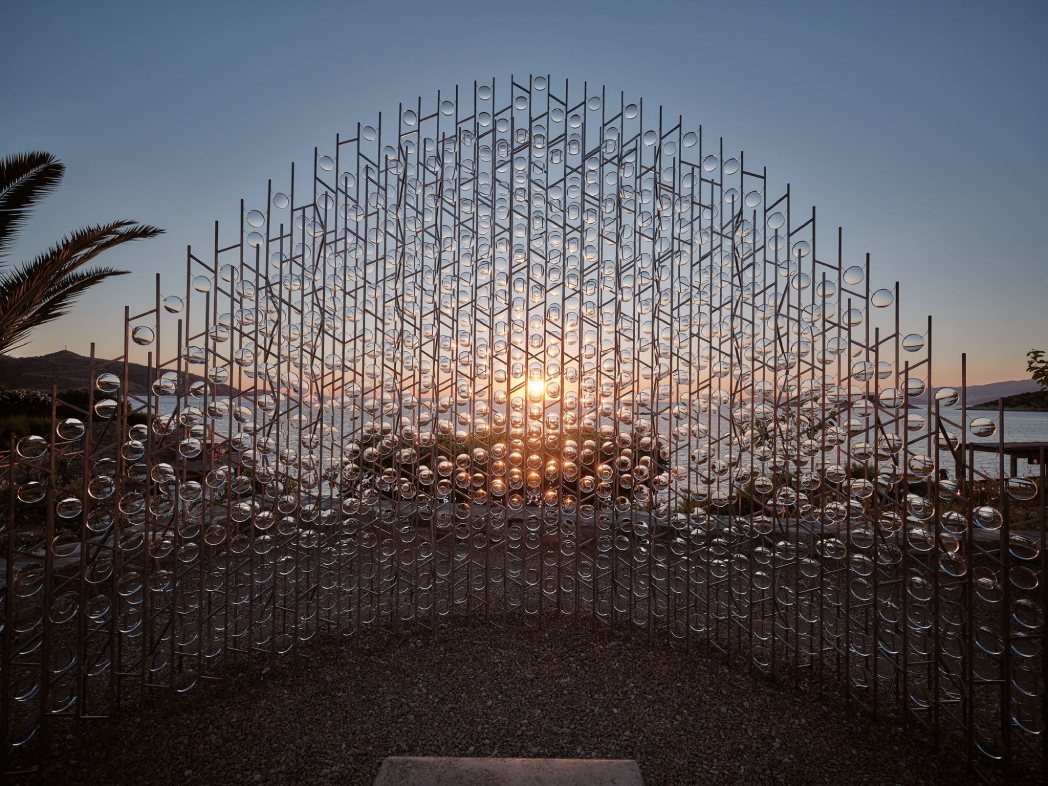
Participation becomes creation. Every person who enters the installation contributes to its evolving narrative. The boundaries between artist, artwork, and audience begin to dissolve, replaced by a collective experience that unfolds differently for each visitor. In this sense, the project embodies a contemporary understanding of public art as a space for encounter rather than a static object of contemplation.
The collaboration between Caitlind Brown and Wayne Garrett is particularly significant because it brings together multiple artistic disciplines. Garrett’s background as a musician introduces a subtle yet powerful musical sensibility into the project. The circular form establishes rhythms and repetitions that echo musical structures, while the movement of visitors generates an ever-changing choreography within the space. Light, landscape, architecture, and human presence combine to create an experience that is simultaneously visual, spatial, and performative.
The result is a symbolic installation that weaves together mythology, democracy, music, landscape, and human participation. It speaks to Crete’s ancient cultural legacy while remaining firmly rooted in contemporary artistic discourse. More importantly, it reminds us that public space can become a site of dialogue, reflection, and connection.
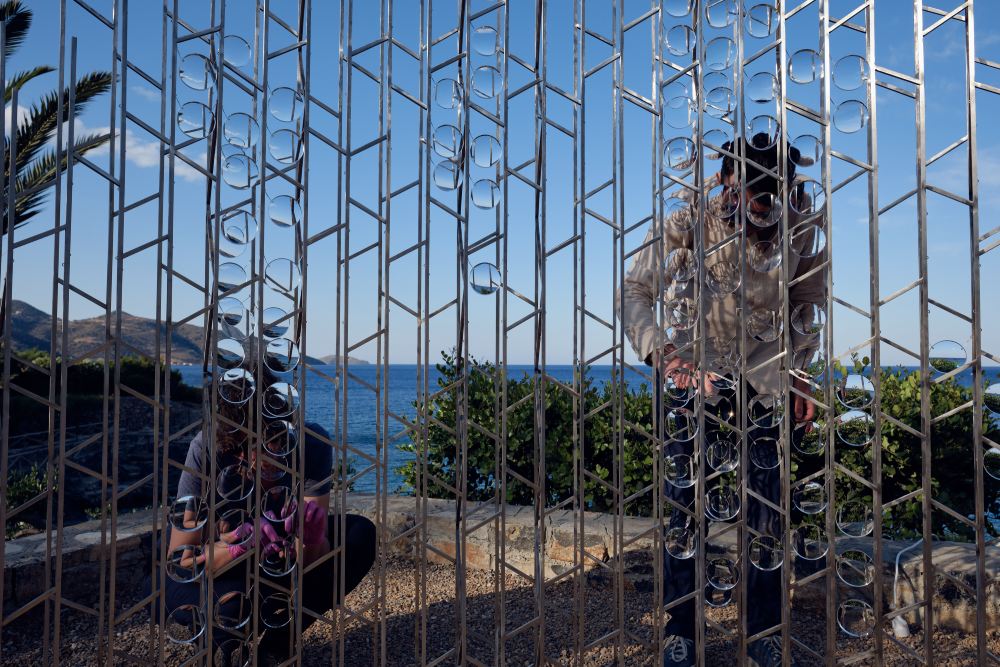
By winning the 2026 Mamidakis Foundation Art Prize, Brown and Garrett have created more than a sculptural landmark. They have offered an invitation: an invitation to slow down, to observe, to participate, and to share a common space. Set within the extraordinary environment of Minos Palace Resort and overlooking the Mediterranean horizon, their installation transforms the landscape into a living conversation between nature, culture, and community.
Ultimately, the work proposes a vision of art as an open and democratic experience. Like the circle that defines its form, it has no beginning and no end. It embraces multiple viewpoints, welcomes diverse interpretations, and celebrates the idea that beauty, meaning, and understanding emerge through participation. In doing so, it stands as both a tribute to Crete’s rich heritage and a powerful reflection on the values that continue to shape our collective future.