

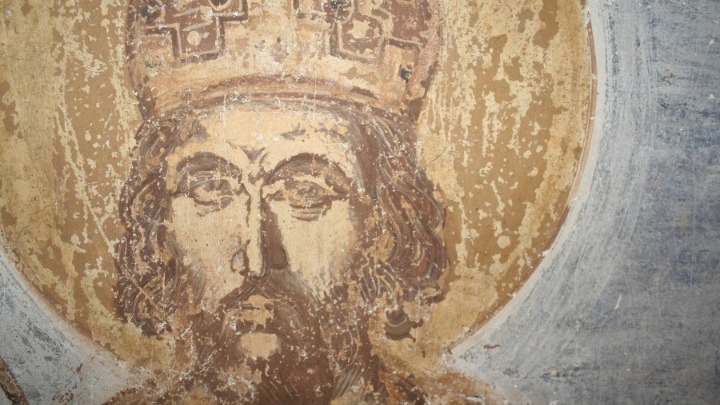
A unique portrait of the last Byzantine Emperor, Constantine XI Palaiologos, has been discovered in the Katholikon of the Old Monastery of Taxiarches in Aegialia. The frescoes, which date from the late Byzantine period, are of high artistic quality and reflect the aesthetic trends of Constantinople. The Ministry of Culture has announced that, during the conservation work at the Katholikon, the central church of a monastery where all the monks gather during services, the archaeologist and director of the Ephorate of Antiquities of Achaia Dr Anastasia Koumousi discovered a unique portrait of the last Emperor of Byzantium Constantine XI Palaiologos, in the second layer of frescoes, which has been safely dated to the middle of the 15th century.
The fresco depicts the figure of a mature man bearing imperial emblems. His gold-embroidered purple cloak is decorated with medals displaying two-headed eagles with a crown between their heads, a distinctive emblem of the Palaiologos family. The presence of the bicephalic eagles on the figure’s garment, together with the other insignia, constituted an unmistakable visual message that identified the man as an emperor.
In an interview with ANA-MPA, Koumousi confirmed that the portrait is that of the last emperor of Byzantium Constantine XI Palaiologos, and that it is fully documented. This is because, as she explained, the combination of historical sources and stylistic criteria allows us to date this layer to the mid-15th century. “It is the only known surviving portrait of the individual in question.” “Portraits of him exist, but they are from two or three centuries later,” she added.
The Monastery of Taxiarches is located 15 kilometers south of Aigion, at the foot of Mount Klokos. The Old Monastery of Taxiarches, also known as Palaiomonastero, is situated one kilometre higher. It was founded by Hosios Leontios of Monemvasia at the end of the 14th century. The despots of Mystra, Thomas and Dimitrios Palaiologos, provided financial support for the monastery by constructing numerous buildings on the site.
The monastery is accessed via a gate tower with defensive openings. The Katholikon (main church) is located on an extended terrace, where the main buildings are concentrated. The South Chapel is located to the south of the Katholikon. To the north of the
Katholikon, at a lower level, you will find the North Chapel. A substantial stone staircase, comprising a wooden upper section and constructed in 1810, provides access to the upper terrace of the monastery. This terrace houses the hermitage of Hosios Leontios, the single-aisled vaulted church of the Resurrection, and the tomb of Hosios Leontios, arranged in a stepped configuration. The four churches of the monastic complex are adorned with high-quality wall paintings dating from the Late Byzantine period.

