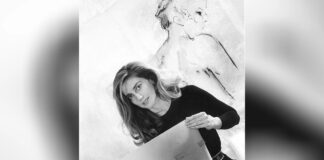

The Hellenic American Union presents The Absence of the Present, the first solo painting exhibition by visual artist Nikos Kanoglou, curated by the art collective Wooden Horse, of which the artist is a founding member. The exhibition unfolds as a meditation on time, memory and the subtle energies that remain embedded in matter, inviting viewers into a space where presence is sensed precisely through its disappearance.
Kanoglou’s practice does not seek to depict landscape or narrative in conventional terms. Instead, his works operate as maps of residue — visual fields where traces of lived experience, erosion and silence emerge as primary protagonists. Through drawing, restrained monochrome palettes and layered materials such as graphite, ink and mineral powders, the artist constructs surfaces where form coexists with void, and where storytelling remains suspended rather than declared.
Within this visual language, Greek cultural memory intersects with archetypal forms and mythological echoes, generating what might be described as a personal mythological terrain. The exhibition proposes a mode of viewing grounded in stillness: the gaze is not asked to decipher but to dwell, to listen to the whisper of time and to recognise memory’s imprint within each mark and shadow.
In conversation with Artviews, Kanoglou describes his new body of work as a mapping not of places but of traces. While rooted in real geographies — notably Arcadian landscapes and historically charged architectural shells — the paintings ultimately capture the lingering energy of spaces rather than their physical appearance. Fragments of surfaces, textures of decay and layers of plaster-like material become vehicles through which memory is extracted from the body of space and reconstituted as an interior landscape.
His academic background in design and architecture lends the work a disciplined structural foundation. Even the most atmospheric compositions are underpinned by carefully organised tonal systems and spatial relationships. Narrative, therefore, unfolds not literarily but spatially: figures and marks inhabit a constructed memory-field, suggesting presence while withholding explicit story.
Travel constitutes another formative influence. Museums, weathered surfaces and the quiet intensity of artistic heritage inform his material sensibility. Rather than returning with images, the artist accumulates a density of memory that later crystallises into matter. Mythological archetypes — Pan, the Ceryneian Hind or Dionysian clusters — appear not as folkloric illustrations but as enduring symbolic structures linking individual and collective consciousness.
As a founding member of Wooden Horse, Kanoglou views artistic collectivity as a dynamic meeting point between thought and action. Collaboration becomes both dialogue and challenge, testing the singular voice within a shared cultural framework.
Ultimately, The Absence of the Present is less an exhibition than an experiential environment. Silence functions as narrative, materiality as memory and shadow as orientation. Kanoglou’s paintings resemble maps where identity, time and matter converge — terrains in which light emerges only after darkness, and where the act of viewing becomes a contemplative encounter with the unseen persistence of memory.