-Over the last 15 years, my international curatorial activities have led me to research zones of tension, where histories, power structures, and identities collide. Through exhibitions in Europe, the Middle East, and the U.S.,
I use the exhibition space as a site of negotiation between centre and periphery, heritage and global contemporary language, visibility and erasure. This has brought me to work with the Al Qasimi Foundation for Policy Research in Ras Al Khaimah, since 2021, where I curate exhibitions as part of the annual Ras Al Khaimah Art Festival and lately the first edition of the Ras Al Khaimah Art Biennale: “Civilisations: Under the Same Sky”.
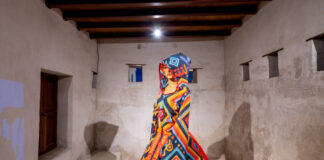
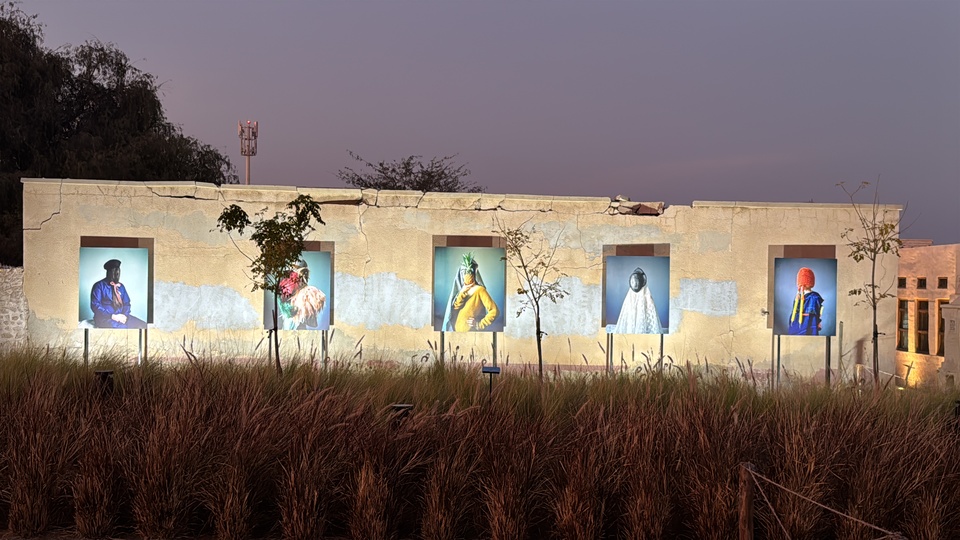
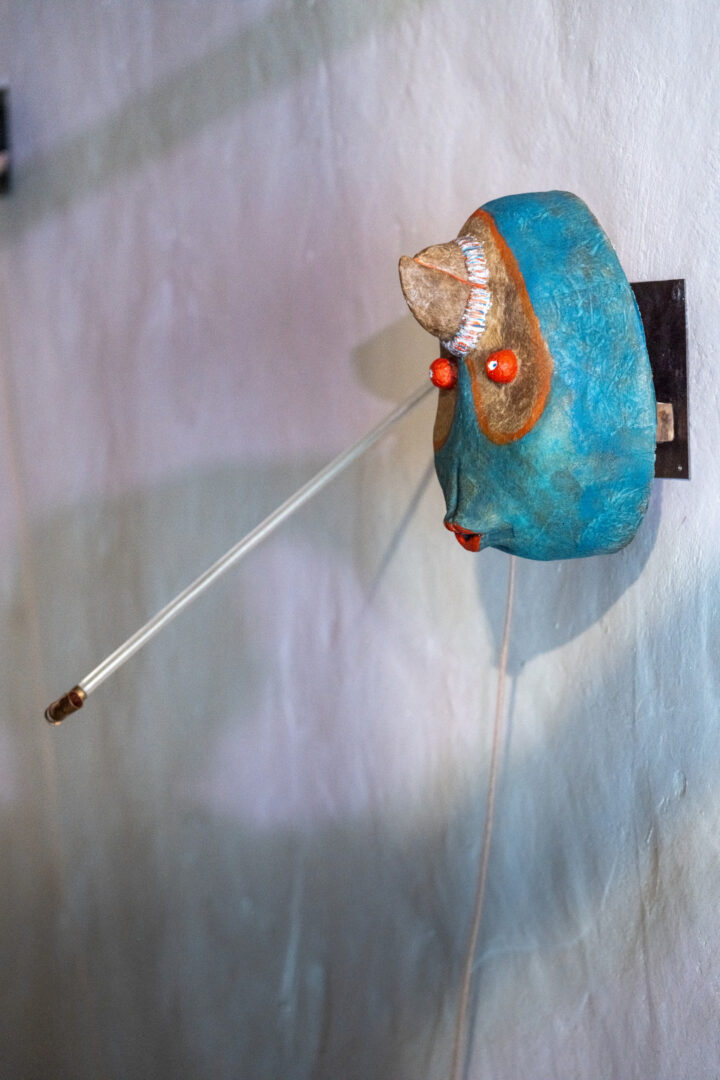
My exhibitions there explore tensions between local heritage and global contemporary language, where contemporary and often technologically driven artworks coexist with historically and culturally charged environments, such as heritage architecture and traditional urban fabrics (Al Jazeera Al Hamra Heritage Village).
-Do these juxtapositions generate meaningful dialogue, or do they risk aestheticising heritage for a global gaze?
-By placing installation, video, and AI‑related works in dialogue with local histories, I wanted to ask how different civilisations coexist in the present: not as a linear narrative, but as overlapping temporalities and competing imaginations of the future.
-As a linear narrative, but as overlapping temporalities and competing imaginations of the future. Still, whose future is being imagined, and who gets excluded from that vision?
My perspective on cultural and artistic activity in the UAE allows me to view the Gulf states more broadly as both importing Western cultural models and actively adapting them to their own social, economic, and geopolitical contexts. By licensing major Western brands and formats, “universal” museums, biennales, art fairs, and blue‑chip auction circuits, they appear, at first glance, as cultural colonies of Western art, reliant on its canons, advisors, and display logics.
-How “universal” are these models, and who granted them that status?
-In this sense, much of what we see can be read as a soft‑power extension of Western modernity; European and North American narratives are re-staged in spectacular new architectures, often in contexts where local publics have limited space for dissenting cultural voices.
At the same time, those very mechanisms are being learned, internalised, and strategically repurposed. Gulf institutions are rapidly becoming producers of their own canons, collecting and exhibiting Arab modernism and contemporary regional practices, foregrounding Gulf histories and epistemologies, and framing themselves as mediators and leaders in historiography rather than mere recipients of “global” culture. Curators, collectors, and policy‑makers in the region increasingly articulate an explicit ambition to shift the art‑historical and institutional centre of gravity eastwards.
So, the question is not “colony now, replacement later,” but a more complex present, Western art structures function as a transitional operating system, while Gulf actors’ experiment, sometimes subtly, sometimes very visibly, with provincialising Western centrality and authoring new, region-driven definitions of what counts as global art.
-You have been curating in the UAE since 2021. What immediately struck you about the art ecosystem there compared to Europe or Israel? What defines an “ecosystem” in a context that is still actively forming? And how does one recognise maturity in such a system?
-What we call today the “ecosystem” of the art world is an extension of the notion of the Artworld, first articulated by Arthur Danto in his seminal 1964 essay The Artworld, published in The Journal of Philosophy.
Danto argued that what makes something art is not its inherent aesthetic qualities, but its recognition within an institutional and interpretive framework—a network of critics, curators, collectors, galleries, museums, and historians who collectively produce meaning.
-But how stable is this framework today? And who has the authority to enter or reshape it? This institutional and discursive network is what we now often describe as the art ecosystem—but is it a closed system, or one that is constantly expanding and redefining itself?
-In addition to my curatorial work in the Emirate of Ras Al Khaimah, I recently began teaching Exhibition Project Management in the master’s program in Art History and Archaeology at Sorbonne University Abu Dhabi. Some of my students were already active in the art field, and some have interned in galleries and cultural institutions, gaining first-hand experience of this ecosystem in practice.
-But what does it mean to “learn” an ecosystem from within while it is still evolving? And how does education interact with institutional development?
What is particularly striking about the UAE art scene is its diversity. Each Emirate has developed its own cultural identity—but are these identities complementary, or do they reveal underlying competition for cultural authority? At times they seem to compete, and at other times they complement one another—yet who benefits from this dynamic?
–Dubai is largely driven by internationally established commercial galleries such as Perrotin, Leila Heller Gallery, Isabelle van den Eynde Gallery, and Carbon 12, among others. It also hosts Art Dubai, which plays a central role in the regional art market. But to what extent does a market-driven model shape artistic production? And does commercial visibility necessarily translate into cultural depth?
Abu Dhabi, by contrast, is defined by its major institutional projects. The Louvre Abu Dhabi has become a landmark museum in the region, and the Guggenheim Abu Dhabi is scheduled to open on Saadiyat Island. Cultural spaces such as Manarat Al Saadiyat further contribute to the Emirate’s institutional profile. Another major development in Abu Dhabi’s art calendar concerns its flagship art fair. For nearly two decades, Abu Dhabi Art has been a cornerstone of the UAE’s cultural scene. Beginning in 2026, it will be replaced by Frieze Abu Dhabi. But what does this transition signify? A deeper integration into the global art market—or a dependency on its structures?
Sharjah has positioned itself differently, focusing on non-profit institutions and critical contemporary discourse. The Sharjah Art Foundation and the long-established Sharjah Biennial are internationally recognised platforms for research-driven contemporary art. But can criticality flourish within institutional frameworks, or does it require alternative, independent spaces?
Ras Al Khaimah has historically had a more locally oriented cultural scene. Through my work with the Al Qasimi Foundation for Policy Research, we have been introducing international contemporary art practices and curatorial methodologies, contributing to the Emirate’s emergence as a new cultural actor. RAK is gradually positioning itself within the broader contemporary art landscape of the UAE—but what defines visibility in such a landscape? And who decides when an “emerging” scene has fully arrived?
On another note, the Ras Al Khaimah Art Festival places a strong emphasis on democratising the arts to less privileged audiences through its educational programs for schools during the Festival each year. But can short-term initiatives create long-term cultural engagement? And how do we measure impact in this context?
One key difference between the UAE and cities such as New York, Berlin, London, Paris, Athens, or Tel Aviv is the relative absence of a strong alternative scene—non-profit galleries, artist-run spaces, and curator-led independent initiatives. In many global art capitals, these alternative spaces function as experimental laboratories and engines of artistic innovation. In the UAE, this layer of the ecosystem is still in the process of developing. But can an ecosystem truly innovate without such spaces? Or will new forms of experimentation emerge within existing institutions?
Taken together, each Emirate represents a distinct ecosystem, yet collectively they form a unified national cultural landscape. Another difference—probably due to the early-stage maturity of these art scenes—is that these institutional ecosystems are still not fully translating into support for the next generation or less-privileged communities engaging with art. There is still a lack of programs in schools and qualified art teachers, and it remains largely a space for elites. But is this a temporary condition, or a structural limitation?
The UAE audience is highly diverse. With expatriates representing nearly 90 per cent of the population, the cultural public is multicultural and international. There is an audience for every field, from experimental contemporary practices to traditional art forms and Emirati cultural heritage. But can such diversity produce a cohesive cultural identity—or does it resist singular definition altogether?
Through my work with the Al Qasimi Foundation for Policy Research, I see myself as contributing not only international artistic knowledge but also professional curatorial methodologies and exhibition practices that strengthen the local ecosystem and foster dialogue between local and global perspectives. Yet this raises a final question: is this dialogue truly reciprocal—or does it still move predominantly in one direction?