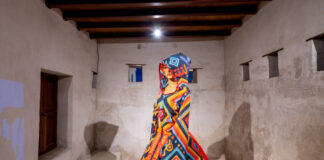

The inaugural Ras Al Khaimah Contemporary Art Biennale will open on January 16, 2026, as part of the Ras Al Khaimah Art Festival 2026, transforming the historic Al Jazeera Al Hamra Heritage Village – a 17th-century Fisherman and pearl cultivating Village – into a vibrant crossroads of art, heritage, and contemporary thought.
Curated by Sharon Toval, this first edition — titled Civilizations: Under the Same Sky — reflects a new vision connecting the Ras Al Khaimah community to contemporary creation from around the world. It invites visitors to embark on a journey through four thematic pavilions exploring humanity’s shared spirit, creativity, and future potential.
Rather than viewing civilizations as relics of the past, the Biennale presents them as living, breathing frameworks of identity, memory, and imagination. Through immersive installations, photography, video, sound, and craft, the exhibition celebrates the diversity of human expression and the common threads that unite us across cultures.
Participating Artists
Sutee Kunavichayanont – Stefano Cagol – Hannan Abu-Hussein – Hicham Benohoud – Marie Hudelot – Dadoune Miyazawa – Miguel Ripoll – Kawita Vatanajyankur – Yifat Bezalel – Samaneh Roghani – Kenji Kojima – Francesca Fini
Vincent Martial – Rotem Tamir – Romain Thiery – Thodoris Trampas – Sophy Abu Shakra – Gökçen Dilek Acay – Lupie Lup – Barak Rotem

A Journey Through Four Pavilions
The Biennale unfolds across four thematic pavilions (villas), each situated within the 17th-century evocative architecture of the Al Jazeera Al Hamra Heritage Village — tracing a path from the spiritual to the futuristic.
Pavilion I — The Spirit Within
Since the dawn of time, human beings have sought meaning through their connection to the spiritual. Across cultures and generations, they have shaped belief systems, rituals, and values that not only define how we relate to the world but also reflect our inner selves.
The spirit finds expression in our relationship with nature, the languages we speak, the art we create, and the ways we perceive reality. These are more than cultural markers; they are echoes of the soul.
This pavilion invites visitors to enter a space where the intangible becomes visible, exploring how the spiritual and cultural converge to shape identity.

Defiant Dancing Corps
Maze: Sublimation printing on semi-transparent fabric
2025
Pavilion II — Under the Same Sky
Over the past two decades, there has been a renewed appreciation for traditional crafts—objects once deeply rooted in heritage, tribe, and memory. But what happens when emerging technologies and artificial intelligence begin to shape the way we design, create, and think?
This pavilion explores that question through artworks that merge ancient sensibilities with contemporary tools. You’ll hear the haunting sounds of abandoned pianos—symbols of Western musical grandeur—recorded in long-forgotten spaces.
These works reflect on the tension between cultural legacy and our fleeting presence on Earth. In the vastness of the cosmos, we are small. And yet, under one sky, we remain connected.

Pavilion III — Visions from the Source
Across history and sacred texts, women have stood at the heart of human existence—shaping societies, nurturing families, and carrying cultural memory. As civilizations evolve, women artists continue this legacy, transforming lived experiences, emotions, and identities into resonant works of art.
This pavilion celebrates the voices of female artists, opening windows into personal and collective worlds—spaces of beauty, resilience, and truth. From bold AI video visions to immersive installations, the works reveal the layered complexity of womanhood across continents.

Camouflage Aux Plumes,
Photography,
2013
Pavilion IV — Future Horizons
In an era of accelerating change, art and technology converge to imagine new possibilities for humankind. This pavilion explores speculative futures—where AI, data, and digital tools coexist with myth, ritual, and memory.
The works question what it means to create, to dream, and to belong in an age when the boundaries between the physical and virtual blur. Each piece is a vision of the possible, a reminder that the future is not distant but alive within us.

Posh on Mars
Mars-ini
Jade on Mars Series
AI Videos 6:34′, 2:22′
2024-2025
“Civilizations: Under the Same Sky”
Humanity has entered a profound transitional era, one in which uncertainty has become the prevailing condition and long-sustained illusions are collapsing one after another. This historical moment is marked by an accumulation of chaotic conflicts, prolonged wars, and the persistent circulation of hatred. Such instability is not only geopolitical; it is epistemological and cultural. Contemporary art inevitably mirrors this state of flux, responding with critical urgency not only to the content it addresses but also to the very foundations of artistic creation itself. Fundamental questions resurface: What is considered genuine art today? What defines authorship, intention, and human presence in an era of accelerated transformation?
More than a century after Marcel Duchamp’s Fountain (1917), contemporary art appears to be consciously circling back toward traditional modes of thinking, making, and presenting. Craft, materiality, and embodied labor re-enter the artistic process, not as nostalgia, but as an assertion:
a desire to affirm the human hand, the human gesture, and the human voice. This return is further intensified by the growing presence of artificial intelligence across multiple layers of artistic production. Faced with algorithmic creation, humans feel compelled to declare, once again,
“I am not a robot.” In this context, diversity emerges not as a challenge but as a vital strength.

Way to Silence
Sound and Sculptural Installation,
2024
The first edition of the Ras Al Khaimah Contemporary Art Biennale, Civilizations: Under the Same Sky, invites visitors to step into a constellation of experiential portals that reveal the richness and complexity of humanity’s plurality. Through the exhibition, tribal rituals are reimagined through advanced digital tools; craft practices echo ancient traditions while remaining deeply contemporary; women’s voices resonate across time and geography; and art’s spiritual dimension unfolds across cultures. Alongside these perspectives, visions of the future emerge, provoking both hope and unease and raising essential questions about what lies ahead.
This first edition is presented as part of the RAK Art Festival 2026 and unfolds throughout the renewed Al Jazeera Al Hamra Heritage Village, the last remaining traditional pearling village in the Gulf region. Within this historically charged setting, internationally renowned multidisciplinary artists come together to open a shared space for reflection and encounter. Here, life is revealed as a vast and interconnected tapestry, woven from differences rather than uniformities. Civilizations are not presented as distant relics of the past, but as living, breathing, and organic frameworks, shaped by identity, memory, belief, and imagination.
The journey begins in the first pavilion, where visitors are immersed in spiritual and metaphysical dimensions. In his meditative video installation, Sutee Kunavichayanont gently decelerates time through fragile natural phenomena: raindrops touching the surface of a river, text slowly evaporating on a heated floor. Nearby, Stefano Cagol’s performance on Norway’s remote Golta Island, filmed beneath the midnight sun, confronts viewers with a moment of transcendence unfolding within a context of ecological fragility and planetary uncertainty.
Moving onward, photography opens new perceptual and conceptual horizons. Hicham Benohoud’s Acrobatie series presents bodies contorted within domestic interiors, at once playful and constrained, revealing tensions between freedom and limitation. In contrast, Marie Hudelot’s Heritage series transforms everyday objects into costumes and totemic forms, reminding us of the symbolic cultural power embedded in even the simplest materials.

The Cocoon of the Butterfly
Video, 4:42’
2024
Traditions throughout the Biennale are reimagined as vessels of memory, resistance, and continuity. Hannan Abu-Hussein’s Samandara, a monumental tower of dowry blankets, honors the often-invisible labor of women while simultaneously evoking the mythic ambition of the Tower of Babel. Sophy Abu Shakra’s CodeX merges embroidery with digital coding, carving intricate patterns into olive tree wood and bridging ancestral craft with contemporary technological language. Questions of gender equality and social justice emerge powerfully in Samaneh Roghani’s Defiant Dancing Corps, a maze of self-portraits mapping women’s struggles, as well as in Kawita Vatanajyankur’s performances, where her body becomes both tool and site, interrogating labor, consumerism, and entrenched gender roles.
Simultaneously, the Biennale emphasizes the coexistence of multiple voices, ancestral and futuristic, intimate and collective. This resonance is felt in the haunting silence of abandoned instruments in Romain Thiery’s Requiem pour Pianos, and in the tactile, handwoven textiles of Rotem Tamir, whose works dissolve the boundaries between traditional craft and contemporary sculptural form.
Looking forward, art and technology open speculative pathways into possible futures. Francesca Fini’s Posh on Mars, an AI-based YouTube series, imagines new mythologies of survival, identity, and adaptation in an uncertain tomorrow, where the boundaries between fiction, technology, and belief continue to blur.
Ultimately, Civilizations: Under the Same Sky proposes that civilizations do not thrive through uniformity, but through multiplicity. Here in Ras Al Khaimah, beneath a shared sky, visitors are invited to see, to listen, to reflect, and to imagine together the worlds we might yet build.
Curator: Sharon Toval

Spiritual painting