

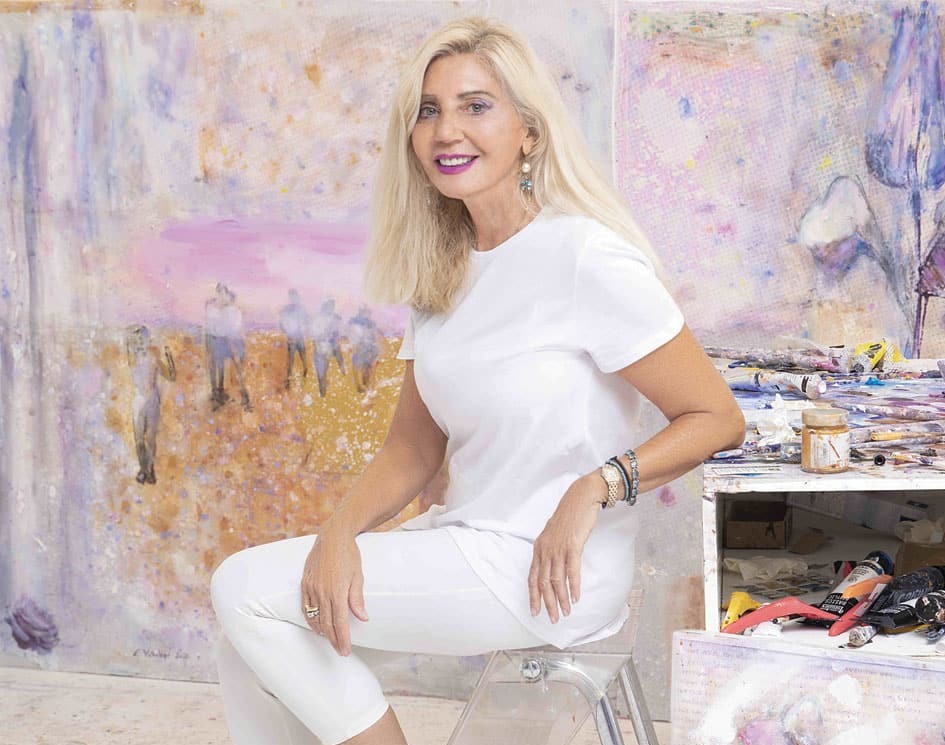
Greek visual artist Erietta Vordoni has developed a distinctive artistic language that combines philosophical reflection with experimental materials, creating works that invite the viewer into a contemplative, almost meditative visual experience. Her practice moves between painting, mixed media, and spatial installations, often exploring the relationship between the material and the immaterial, light and transparency, memory and perception. Through her work, Vordoni seeks not only to construct images but also to create emotional and intellectual spaces where the viewer can pause, reflect, and reconnect with a deeper sense of inner balance.
A key element of Vordoni’s artistic approach is her interest in philosophical thought, particularly ideas related to the pursuit of happiness and the search for harmony in a world marked by uncertainty. Her work frequently draws inspiration from ancient Greek philosophy, especially the teachings of Epicurus, who emphasized the importance of simplicity, friendship, and the cultivation of inner peace as paths toward a fulfilled life. In Vordoni’s artistic universe, these philosophical concepts are translated into visual forms that evoke tranquility, introspection, and the quiet strength of nature.
The artist’s creative process is deeply influenced by her academic background in Philosophy of Art at the Sorbonne in Paris, a formative experience that exposed her to a wide range of cultural perspectives and artistic dialogues. Living and studying in Paris allowed her to engage with artists and thinkers from different parts of the world, broadening her understanding of contemporary artistic practice while encouraging her to develop a personal visual language rooted in both intellectual inquiry and emotional expression. This encounter with international artistic environments gave her the freedom to experiment and to give shape to her own visions.
One of the most distinctive aspects of Vordoni’s work is her use of transparent materials, particularly plexiglass, which she treats as both surface and space. By painting and intervening on both sides of the transparent plane, she creates layered compositions that interact with light and the surrounding environment. These works often appear to shift and transform depending on the viewer’s position, producing the impression that the image is breathing within the space. Transparency becomes not only a visual effect but also a metaphor for fragility, openness, and the fleeting nature of experience.
Color also plays a central role in Vordoni’s visual vocabulary. Among the hues that dominate her compositions, blue appears frequently as a symbolic and emotional anchor. For the artist, blue is connected to memory and to the landscape of Greece — the sky and the sea that define the country’s visual identity. At the same time, blue functions as a psychological space: a color that invites introspection and calm, suggesting what Vordoni describes as a form of “inner silence.” Through subtle variations of tone and light, her works often create an atmosphere of quiet contemplation.
Vordoni’s artistic language is also characterized by the interplay of contrasts. Hard and soft materials, opacity and transparency, density and lightness coexist within her compositions. She often combines elements such as metal, textiles, lace-like textures, and iridescent enamels that change color depending on the light. These juxtapositions reflect the complexity of contemporary life, where opposing forces coexist and must find a form of equilibrium. In this sense, the artist’s work becomes a metaphor for the human condition, proposing harmony not as the absence of tension but as the ability to integrate differences.
Nature, too, occupies an important symbolic place in Vordoni’s work. The recurring image of the garden serves as a powerful metaphor for life itself — a space of beauty, growth, and transformation, but also one that requires awareness and care. In her artistic vision, the garden represents the inner landscape that each individual cultivates through experience, knowledge, and emotional awareness. Just as a garden contains both flowers and hidden obstacles, life unfolds through moments of joy, difficulty, discovery, and renewal.
Ultimately, Erietta Vordoni’s work proposes a form of artistic reflection on the possibility of happiness and inner harmony in an increasingly complex world. Rather than offering definitive answers, her artworks function as invitations — quiet visual environments that encourage viewers to slow down and engage with their own inner perceptions. By combining philosophical inquiry, material experimentation, and a poetic sensitivity to light and color, Vordoni creates an artistic practice that bridges ancient ideas and contemporary experience, reminding us that the search for balance and meaning remains a timeless human endeavor.


