Interview: Zeta Tzioti
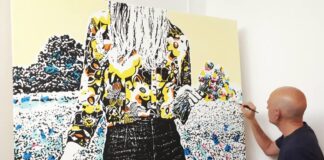
Victor Koen’s illustration has long operated on the threshold between visual poetry and sharp commentary on contemporary society. Based in New York and present internationally through publishing houses, cultural institutions and universities, the artist has developed a visual language recognizable for its symbolic power, meticulous detail and conceptual precision.
From his studies at the Bezalel Academy to his long-standing relationship with the School of Visual Arts in New York, Koen approaches the image not merely as an aesthetic event but as a field of ideas. In his work, personal experience intersects with political commentary, while illustration expands beyond print, finding its place in digital platforms, objects, installations and large-scale public murals.
Of particular interest is his recent collaboration with AKTO, through which he connected with a new generation of creators in Greece, sharing experiences from the international artistic and educational scene.
In the conversation that follows, he speaks about navigating different artistic cultures, the challenges of contemporary illustration, the relationship between creativity and artificial intelligence, and the choices that shape the professional and ethical identity of an illustrator in the international market. It is a discussion about the power of images in a constantly changing world.

– Victor, as Chair of the Illustration and Comics departments at SVA, how do you see the profile of the contemporary illustrator changing in recent years?
The main difference is that today illustrators work across multiple applications of their images. The image no longer lives only on paper. It can exist in print, online, in motion, on objects, or even on walls as murals.
This expansion changes the way we think about and design images. Illustrators are now called upon to work across different scales, materials and platforms.
– What was the most defining lesson you received from Bezalel, and what from New York?
Bezalel taught me to work hard and to pay attention to detail. It was a school that cultivated discipline and technical precision.
The School of Visual Arts in New York pushed me to look inward. To express my deepest ideas and obsessions — even those that are difficult to name.
The combination of these two experiences shaped my direction and ultimately made me a professional.
– Your work often balances between political commentary and poetic allegory. Where does the message end and where does art begin?
Art is always a message. It can be personal or it can serve a client.
The goal is to combine the two when possible and to keep them separate when necessary. That is where the balance lies.
– In an era when artificial intelligence can produce images in seconds, what do you believe is the irreplaceable value of the human concept?
The irreplaceable value of the human concept is its uniqueness. Unlike the average that artificial intelligence inevitably produces, a human idea can be truly singular.
The creator expresses that uniqueness through their art and, when necessary, even through the use of AI as a tool.
Speed or quality is a choice — both for clients and for artists.

– How do you decide which commercial collaborations to accept? Is there a “red line”?
For an illustrator who signs every piece of work, ethical red lines — especially early in one’s career — can be a significant luxury. You can only afford them if you have two jobs.
I always made sure I had three. That way I could say no to collaborations that didn’t represent me.
– Which of your works do you consider the most personal, even if it was created for a major publishing organization?
Editorial illustration, especially when you collaborate with clients you know well, offers great opportunities for work that can easily be considered personal.
When you only show work that you truly like, you attract clients who are aligned with you.
– What advice would you give to a young Greek illustrator who wants to build a professional career abroad?
First, they must make sure they are truly ready: in terms of artistic process, critical thinking, quality of ideas, technical skills and professionalism according to the standards of the international market.
I would suggest living abroad, even for a while. Participate in competitions, become an active member of the professional community. Give and receive.
– How did you experience your collaboration with AKTO? Are there differences in the creative culture of students in Athens and New York?
Our collaboration was excellent, and I am truly honored by the invitation. The enthusiasm and professionalism of the AKTO team are genuinely impressive.
It is difficult to compare the highly diverse and international profile of art school students in New York with that of Athens.
However, students everywhere possess energy, talent, resilience, anxieties, wings and superpowers that we older generations can only envy — hoping that sometimes they will allow us to protect them, even from themselves.
– How important is materiality — the object and the three-dimensional form — in what is essentially a “flat” art such as illustration?
Materiality is something that interests me more and more.
For example, my new visual series is printed on silk, something that radically changes the experience of the image.
– If you could illustrate a global event of our time with a single image, what would it be?
My role at the School of Visual Arts and collaborations such as the one with NASA have already fulfilled dreams I didn’t even know I had.
I believe that dedicating oneself to something as meaningful as education, combined with the continuous development of one’s personal work, naturally brings unexpected collaborations and new visual adventures.